
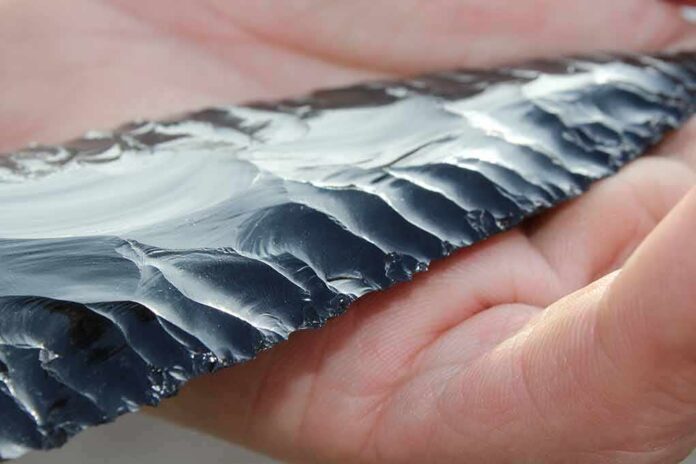
Long before the bow became a symbol of human ingenuity in Greek myth or medieval warfare, someone in a limestone shelter above the Palтau valley in what is now Uzbekistan may have already strung one — and used it to bring down game with a projectile smaller than a thumbnail.
Key Points
- A peer-reviewed study in PLOS One identifies tiny, unretouched triangular stone points from Obi-Rakhmat, Uzbekistan, as likely arrowheads dating to roughly 80,000 years ago.
- The points show microscopic impact damage consistent with projectile use, and their small size — some weighing under two grams — makes them a poor fit for anything but arrow shafts, according to the researchers.
- The identification comes from a preliminary analysis of a 20-piece sample drawn from a much larger lithic assemblage, and the authors describe the work explicitly as ongoing.
- Who made these points — Homo sapiens, Neanderthals, or another hominin group present in Central Asia at the time — remains unresolved.
- If the projectile interpretation holds, it would push the archaeological record of archery back tens of thousands of years earlier than most prior estimates.
What Was Found, and Where
Obi-Rakhmat is not a new site to archaeology. Excavators have worked its stratified deposits since the 1960s, and its layered sediments have been dated over the decades using radiocarbon, uranium-series, and electron spin resonance techniques, yielding a chronological span from roughly 90,000 to 40,000 years ago. What is new is the fine-grained look a team led by traceologist Hugues Plisson of the Université de Bordeaux took at the oldest occupation layers, designated levels 20 and 21, dated to approximately 80,000 years ago. Within that material, the researchers isolated a set of tiny triangular stone fragments that had previously gone unnoticed, precisely because their broken, unretouched form made them easy to overlook as mere debris rather than finished tools.
Traceology is the study of microscopic wear patterns left on a tool’s surface and edges by use — the same discipline that lets researchers distinguish a knife from a scraper from a projectile tip by reading the scars invisible to the naked eye. Applying that method here, the team identified three categories of projectile armature among a selection of twenty pieces: retouched points, bladelets, and, most significantly, unretouched triangular micropoints. The micropoints are the headline discovery. Their dimensions are so slight that the authors argue they are “too narrow for having been fitted to anything other than arrow shafts” — ruling out, in their assessment, the heavier spear or dart shafts used with thrusting or hand-thrown weapons.
How Traceology Builds the Case for Arrows
The claim does not rest on the shape of the stone alone. Size is suggestive, but it is the wear pattern that carries the evidentiary weight. Impact against an animal target — bone, hide, muscle — leaves a signature: characteristic fracture forms, linear impact scars, and micro-flaking concentrated near the tip, patterns that decades of experimental archaeology have cataloged by firing replica points into calibrated targets and comparing the resulting damage to archaeological specimens. The Obi-Rakhmat team situates its identification inside that experimental literature, concluding that “the sample is sufficient to highlight the presence of micropoints impacted by use as projectile heads” in the 80,000-year-old layers. This is the same evidentiary logic that supported a comparable claim at Wilamaya Patjxa in South America, where usewear analysis confirmed points long assumed to be projectile tips were, in fact, used that way — a pattern replicated often enough in the literature that traceological identification, while probabilistic, carries real weight when done rigorously.
What the method cannot do, at least not from the stone alone, is put a bow in anyone’s hands. No wood, sinew, or binding material survives from Obi-Rakhmat’s deposits; the bow itself is inferred, not recovered. The chain of reasoning runs from point size and wear pattern to velocity and impact force, and from there to the physics of what kind of weapon could deliver a projectile of that mass with enough energy to produce the observed damage. It is a defensible inference built on established principles of hunting-weapon design, as the authors put it, but it remains an inference rather than a direct observation of a bow in use.
Why the Question of Chronology Matters
Bow-and-arrow technology has long been treated as a marker of a certain threshold in human cognitive and technical sophistication — it requires composite construction, an understanding of stored elastic energy, and precision manufacture of small, standardized parts. Prior to this study, the earliest widely accepted evidence for projectile weaponry of this kind clustered tens of thousands of years later in the record, with African sites such as Sibudu Cave in South Africa frequently cited among the oldest candidates. An 80,000-year date for Central Asia, if it holds, would not just add a data point; it would relocate part of that origin story geographically, suggesting sophisticated projectile technology was in use well outside Africa earlier than the conventional narrative allowed. That is the substance behind headlines calling this a potential rewrite of archery’s timeline, and it is why the finding has drawn attention well beyond specialist journals, including coverage from World Archery’s own news desk.
Who Made Them Remains Open
Central Asia 80,000 years ago was not the exclusive territory of any single hominin lineage. The region sat at a crossroads where Homo sapiens, Neanderthals, and Denisovans are all known or suspected to have been present at various points, and genetic evidence has already established interbreeding among these groups in the broader region. The Obi-Rakhmat shelter itself has yielded human remains, including a juvenile cranium, studied previously for its mix of anatomical traits. The current traceological study does not resolve, and does not attempt to resolve, which population produced the micropoints. That is a genuinely open question, not a gap in the reporting — and it means the discovery’s implications for the specific story of Homo sapiens’ expansion into Central Asia remain provisional until skeletal or genetic material can be tied directly to the same occupation layers.
Reading the Claim With the Right Amount of Caution
The authors are candid that this is a preliminary study built on a selected sample of twenty pieces drawn from a far larger assemblage still under analysis. That is not a weakness unique to this paper; it is standard practice in lithic analysis, where researchers often work outward from a diagnostic subset before committing resources to a full assemblage review. The appropriate posture for a careful reader is confidence in what has been demonstrated — microscopically documented impact wear on unusually small, narrow points from a securely dated 80,000-year-old layer — paired with patience for the fuller catalog, expanded dating tables, and comparative morphometric work that would settle remaining questions about hafting, manufacture, and the identity of the toolmakers. The traceological case for projectile use is solid; the leap to “world’s oldest arrowheads” as settled fact is the media’s shorthand for a hypothesis the researchers themselves still call a working one.
Microlithic projectile points from Uzbekistan may link Central Asia to a revised story of Homo sapiens’ early expansion into Europe. Researchers have identified tiny triangular… https://t.co/CJSiTze7h7 #Archaeology #History #HomoSapiens #AncientCivilizations #Uzbekistan
— Entrepreneur_cm (@entrepreneur_cm) August 30, 2026
What Comes Next
The path to certainty here is well mapped, even if it hasn’t been walked yet. Full publication of the artifact catalog and microtrace imagery would let independent labs test the impact-wear identifications against blinded comparison samples. Controlled replication experiments — firing replica micropoints from bows built to match the inferred shaft diameter — would test whether the physics holds up. And any human remains recovered from the same layers are candidates for ancient DNA or proteomic analysis that could finally attach a face, or at least a lineage, to the hands that shaped these points. Until then, Obi-Rakhmat stands as the best current evidence that someone in Central Asia was already hunting with something resembling a bow 80,000 years ago — a claim resting on careful microscopy, an honest acknowledgment of its own limits, and a story still being written one layer at a time.
Sources:
sciencedaily.com, phys.org, pmc.ncbi.nlm.nih.gov, timesca.com, livescience.com, biorxiv.org, economictimes.indiatimes.com, zamin.uz