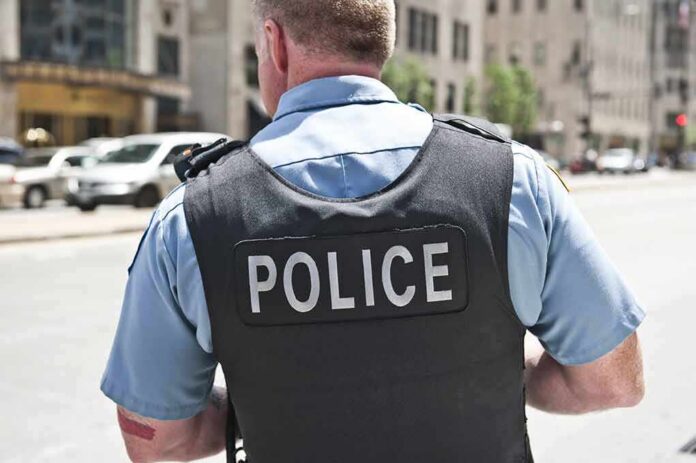
A fake police stop rarely unravels because the impostor loses his nerve — it unravels because he forgets, even for a moment, that he isn’t actually a cop, and reaches for the one resource real officers use without thinking: backup.
Key Points
- Scott Carl Millage, 60, of Cave Creek, Arizona, was arrested on September 17, 2026, after allegedly pulling over a silver Tesla on Interstate 17 using a gray pickup truck rigged with red and blue lights.
- Arizona DPS says Millage called 911 himself during the stop to request police backup — the call that exposed the ruse and brought real troopers to the scene.
- He faces felony charges of impersonating a peace officer, unlawful imprisonment, and kidnapping, according to DPS spokesperson Trooper Randi Wybron.
- Police impersonation is a documented, if statistically rare, crime pattern — researchers who studied a decade of case files found vehicle pull-overs are the most common method impersonators use to approach victims.
- DPS is using the case to renew a longstanding public-safety advisory: unmarked vehicles make it genuinely hard for drivers to distinguish real officers from impostors, and calling 911 to verify a stop is the standard countermeasure.
What Happened on I-17
The incident unfolded on Interstate 17 in north Phoenix, a stretch of freeway that cuts through the fast-growing corridor connecting Cave Creek and the northern suburbs to downtown. According to Arizona DPS, Millage used a gray pickup truck outfitted with red and blue emergency lights to signal a silver Tesla to pull over, mimicking the visual cues drivers are trained from childhood to obey without question. Once the stop was underway, Millage did something no genuine impersonation script anticipates: he dialed 911 and asked for police backup, apparently either out of genuine confusion about his own authority or a miscalculated attempt to lend the encounter legitimacy. Real troopers responded — to the fake officer’s own call.
DPS spokesperson Trooper Randi Wybron confirmed the arrest and the charges in a statement to the Arizona Republic: Millage, 60, “was charged on suspicion of impersonating a peace officer, unlawful imprisonment and kidnapping, all felonies.” Fox 10 Phoenix’s reporting corroborated the vehicle description and the freeway location, noting that DPS used the case as an opportunity to caution the public generally about unmarked vehicles equipped to mimic official law enforcement lighting. Yahoo News, syndicating wire coverage, added the detail that most animated the story’s viral spread: Millage’s own 911 call for backup during a stop he had no authority to conduct in the first place.
Why the Charges Stack the Way They Do
The three felony counts reflect distinct legal theories, not redundant paperwork. Impersonating a peace officer addresses the fraud itself — claiming authority one does not possess. Unlawful imprisonment and kidnapping, by contrast, concern what happens to the victim once that false authority is asserted. Legal treatments of these offenses generally distinguish unlawful imprisonment — restraining someone without consent — from kidnapping, which typically requires restraint paired with movement, confinement, or an aggravating purpose beyond mere detention. Courts across jurisdictions have wrestled for decades with where an ordinary, if unlawful, stop ends and a kidnapping begins; Hawaii’s Supreme Court, for instance, has held that unlawful imprisonment requires restraint under circumstances exposing the victim to risk of serious bodily injury. Whether Millage’s conduct meets that bar for kidnapping specifically, as opposed to the lesser unlawful-imprisonment count, will be determined as the case proceeds through Maricopa County’s court system — a routine next step in any felony filing, not a sign of weakness in the charges themselves.
A Recognizable Pattern, Not a Freak Occurrence
Police impersonation feels like a tabloid oddity, but it is a studied criminal category with recognizable mechanics. One of the few empirical studies on the subject, examining police case files from three agencies between 2002 and 2010, found that impersonators most commonly approached victims through vehicle pull-overs, followed by knock-and-talk scenarios and direct harassment. Later research on what criminologists term “confrontational impersonation crime” — face-to-face encounters where an offender mimics the behavior of a powerful official — reinforces that the traffic stop is the impersonator’s tool of choice precisely because drivers are conditioned to comply first and question later. That conditioning is also the impersonator’s greatest vulnerability: it works only as long as the victim never tests it.
The reason unmarked or lightly marked vehicles remain a persistent public-safety concern is structural. Genuine unmarked patrol units exist for legitimate enforcement purposes — DUI saturation patrols and speed enforcement, chiefly — which means drivers cannot use “no visible markings” alone as proof of an impostor. Longstanding guidance circulated by researchers and law enforcement alike counsels the same verification step DPS is now reinforcing after the Millage arrest: call 911 during the stop itself and ask the dispatcher to confirm that a marked or plainclothes officer is actually assigned to that location. It is a low-friction check that costs a driver nothing and, as this case shows, can expose a fraud almost instantly.
On September 8 two (Former) Phoenix police officers pleaded not guilty to charges stemming from failing to activate body cams and log a "traffic stop" during which a Taser was deployed.
On Aug. 5 at about 11:30om they stopped a couple driving a sports car.
Details:
Court and…— Christopher Fishell (@chieffishell) September 17, 2026
What the Case Signals Going Forward
Cases like this one tend to travel faster through headlines than through courtrooms, and the felony filing against Millage is the beginning of a legal process, not its conclusion — an arrest establishes probable cause, not guilt. But the practical lesson for drivers doesn’t wait on a verdict. Arizona DPS’s public advisory following the arrest — warning specifically about vehicles equipped to imitate emergency lighting — reflects a durable reality: as consumer access to police-style equipment has grown, so has the opportunity for impersonation, and the countermeasure remains unchanged from decades past. Verify before you comply. The remarkable twist in this particular stop, that the impostor called real police on himself, doesn’t change the underlying advice; it just proves how thin the line is between a convincing performance of authority and the moment it collapses.
Sources:
reddit.com, azcentral.com, fox10phoenix.com, azdps.gov, buchananlibrary.org, govinfo.gov, scielo.org.co