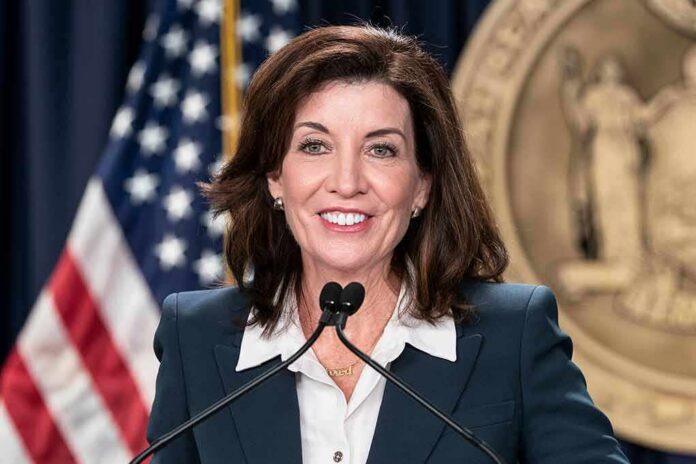
On days of civic mourning, what leaders choose to do—and when they choose to do it—communicates as loudly as any prepared remark; the controversy over Governor Kathy Hochul leaving the 9/11 Ground Zero ceremony early for a CNN appearance is a case study in how ritual, media, and political legitimacy collide in the space of a few hours.
At a Glance
- The factual core is straightforward: Hochul attended the Ground Zero commemoration, departed before the reading of names concluded, and appeared on CNN shortly thereafter.
- Critics frame the early exit as disrespectful to a ritual centered on reading every victim’s name; supporters say the timing aligned with established departure norms for dignitaries and that her TV segment honored victims and responders.
- Such disputes are patterned, not novel: 9/11 commemorations often serve as proxy battles over who may claim moral authority, how officials should behave, and whether media appearances dignify or dilute the day.
- The durable question isn’t whether a calendar was mismanaged, but how public officials should balance presence, symbolism, and national communication on a day designed to minimize politics.
The verified sequence: attendance, departure, and the cable news pivot
The record supports three uncontested points. First, Governor Hochul attended the 25th-anniversary Ground Zero commemoration among a roster of dignitaries and families. Second, she left before the ceremonial reading of the names concluded. Third, she appeared on CNN’s The Situation Room not long after. The New York Post’s same-day coverage fixes the early departure in time and ties it to her scheduled CNN appearance; her office, quoted in that coverage, argues she left when she typically does, alongside other national figures. The governor’s press site, which functions as the formal log of public engagements, reflects both her attendance and the media hit, time-stamped the same afternoon. CNN’s own listing frames the interview explicitly as a remembrance, emphasizing both the fallen and those later lost to World Trade Center–linked illnesses.
These are the bones of the dispute. The disagreement is interpretive: whether leaving while names were still being read signals misjudgment about the day’s core ritual or a reasonable handoff to another form of public remembrance. The timeline itself is not seriously contested by the sources surfaced.
Why the exit mattered: the ritual logic of 9/11 commemorations
The Ground Zero ceremony was designed to resist political theater. No speeches by officeholders; the families, not officials, are centered. In this setting, the act of staying—standing witness through the entire reading—carries its own meaning. The annual reading lasts hours, and completion is not merely procedural; it affirms that no name is abridged by convenience. Against that norm, leaving early is noticed, even if schedules are tight or security choreography nudges dignitaries out before the close. The friction here is built-in: leaders have parallel obligations to attend, to avoid turning the day into a stump, and to communicate at a national scale about ongoing obligations to victims and responders. Every choice emphasizes one value at the expense of another.
This is why 9/11 anniversaries repeatedly become sites of contestation over optics and propriety. In multiple cycles, disputes have erupted over who attends, who speaks, and whether politicians are using the day as a stage. The gravitas of Ground Zero turns small variations—arrival times, position on the plaza, even wardrobe—into moral signals for audiences primed by years of politicized remembrance.
The competing frames: disrespect or responsible commemoration?
Critics position the timing as avoidable and tone-deaf: by definition, leaving before the list is finished means departing before some families hear their loved one’s name read aloud. That symbolism is potent, which is why the complaint caught traction. Supporters counter with two points. First, that high-security, multi-principal events often have structured departure windows for senior figures; the governor’s office says she left when she does “every year,” aligned with other dignitaries, not as a one-off to chase studio lights. Second, that appearing on national television to discuss the anniversary and the long tail of 9/11-related illnesses extends the commemoration’s reach beyond the plaza to a broader public, keeping attention on policy obligations many hours after the bagpipes fade.
Evaluated on evidence, each side is arguing meaning more than fact. The criticism relies on the sanctity of the full reading as the day’s standard; the defense relies on institutional practice and the content of the CNN segment. The documentation we have—the outlet coverage, the official schedule entries, and the program description—supports that both occurred as described.
How we got here: the evolution of remembrance into political stagecraft
Twenty-five years on, the 9/11 ceremony has accrued layers of expectation. Early years prioritized unity and restraint; later cycles—particularly in election seasons—saw the site reframed, often by the press, as a stage where attendance confers seriousness and authenticity while absence invites questions. That dynamic, once external, now shapes officials’ decisions from the outset: show up, say little, be seen—but also demonstrate ongoing stewardship of health benefits, security posture, and education. The result is a narrow corridor for action in which any deviation—an early exit, a second event, a media hit—feels conspicuous. Analyses over recent anniversaries have cataloged this shift from pure memorial to symbolic battleground; in that light, Hochul’s schedule became a screen for projecting deeper anxieties about politics intruding on grief.
Media incentives amplify the cycle. Cable formats are optimized for conflict cues and moral stakes; a clip of an official leaving during a still-unfinished ritual, paired with a studio lower-third about “breaking news” or “commemoration,” invites judgment. The counter-move—publishing a transcript and framing the segment as service to memory and policy—tries to reclaim legitimacy through substance. Both moves are predictable in the current media ecology; neither, by itself, resolves the underlying tension between presence and projection.
What responsible stewardship looks like on days of collective mourning
There is no perfect script. But three principles travel well from year to year. First, center the ritual’s internal logic. At Ground Zero, that means treating the full reading as the day’s spine. If security protocols or other obligations necessitate early departures by principals, communicate those constraints clearly in advance, privately to family organizations and publicly in schedule guidance; surprise breeds suspicion. Second, if leaders use national platforms the same day, make the content relentlessly memorial-centric: names, continuing health impacts, concrete program updates—avoiding even the scent of political opportunism. The governor’s CNN billing emphasizes toxic-exposure deaths and remembrance, which is the right register for the day. Third, close the loop after the fact: publish a transparent, time-stamped record of attendance and messaging so disputes center on values, not guesswork. The pressroom entries here—attendance and the CNN appearance—are the baseline of that practice.
For audiences, the more useful question is less “was this disrespect?” than “did the combination of presence and message advance the obligations the day imposes?” On the available record, Hochul fulfilled the minimum civic duties—attendance at the core ritual and national communication focused on remembrance—while inviting criticism by leaving before the names concluded. Reasonable people will weight those choices differently. The pattern will persist until leaders and institutions align schedules, security, and messaging with the ceremony’s moral architecture instead of asking the ritual to flex around political and media rhythms that, on this date, should yield.
Gov. Kathy Hochul leaves 9/11 Ground Zero ceremony early to appear on cable news show https://t.co/Mum5mWJB1P pic.twitter.com/F6O92CajcK
— New York Post (@nypost) September 11, 2026
Bottom line
The facts are not in serious dispute; the meaning is. In the politics of memory, small choices are loud. On September 11, the most durable authority still comes from standing witness—fully, quietly—and letting every name finish the sentence.
Sources:
twitchy.com, nypost.com, governor.ny.gov, cnn.com