
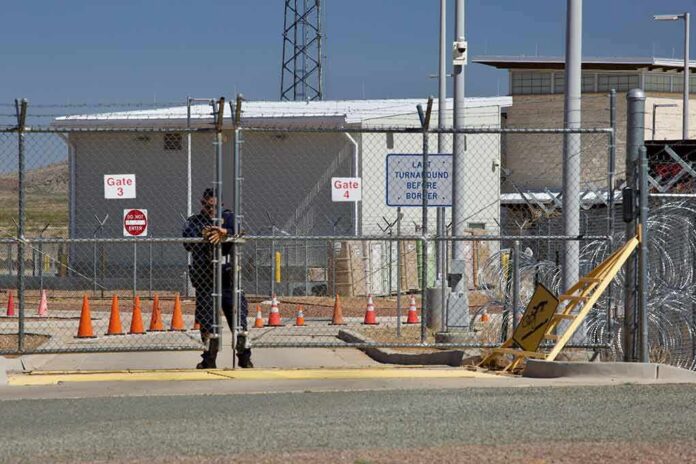
When a civilian breaches a U.S. Air Force base gate, the response is swift, rehearsed, and unforgiving because the access-control point is the installation’s most vulnerable choke point—and the incident at MacDill Air Force Base underscores exactly how that system is designed to work under pressure.
At a Glance
- Around 1 p.m., a civilian breached MacDill AFB’s perimeter at the Dale Mabry Gate and “violently engaged” security personnel, according to base-linked reports.
- Security forces detained the individual; both the civilian and a security officer sustained non-life-threatening injuries and received medical care.
- MacDill closed the Dale Mabry Gate to inbound and outbound traffic after the incident, consistent with force-protection protocols.
- The account comes from base public affairs and aligned local/national reporting; it matches long-established Air Force access-control doctrine.
What Happened at MacDill’s Dale Mabry Gate
Multiple contemporaneous reports attribute to MacDill’s 6th Air Refueling Wing Public Affairs that a civilian breached the base perimeter near 1 p.m. on a Saturday and then “violently engaged” security personnel at the Dale Mabry Gate. Security forces detained the individual. Both the suspect and a security officer were transported for treatment of non-life-threatening injuries; the installation subsequently closed the gate to traffic pending recovery actions and scene control. The timing, location, and core sequence—the breach, the violent encounter, detention, injuries, and gate closure—are consistent across outlets that rely on the base’s public affairs account.
Air bases train for exactly this contingency. Access-control points are engineered to funnel vehicles and pedestrians through layered checks—identification verification, barriers, standoff distance—and to give security forces time to detect and defeat a gate runner or an aggressive intruder before critical assets are threatened. The post-incident gate shutdown is not window dressing; it is a textbook step to preserve evidence, re-establish positive control, and prevent secondary disruptions while medical and investigative teams work.
How Access-Control and Security Forces Respond
Air Force installation defense doctrine treats the perimeter and gates as the outer skin of a broader “defend, delay, and defeat” architecture. Sensors, cameras, pop-up barriers, and rehearsed traffic-control measures are integrated with trained security forces to turn time and distance into protection. When someone breaches a gate or disregards commands, response escalates through established use-of-force tiers—verbal commands, physical control techniques, nonlethal tools, and, if necessary, lethal force—calibrated to stop the threat while minimizing collateral harm. The reported outcomes at MacDill—rapid detention and non-life-threatening injuries—fit the profile of a hard stop that did not escalate to deadly force.
These procedures were codified and refined across the force after several high-profile gate incursions over the past decade. Episodes such as the 2017 Mildenhall gate-runner incident spurred significant changes in infrastructure, tactics, and training to ensure installations can neutralize a breach in seconds, not minutes. The aim is simple: deny an intruder freedom of movement inside the fence line, where aircraft, munitions, command nodes, and personnel are concentrated.
Why Gates Close and Information Is Tightly Managed
Closing a gate after an access-control incident serves three purposes. First, it restores the physical security baseline—barriers re-set, lanes cleared, guard rotations adjusted. Second, it preserves the scene for investigators: tire marks, debris, badge scans, and radio logs are evidence. Third, it reduces ambiguity for the traveling public: routing traffic to other gates standardizes control while forces reset. That sequence aligns with Air Force consequence-management phases, which emphasize detect, assess, warn, and then recover in an orderly fashion.
Initial public information typically comes from the installation’s public affairs office. That is not a public-relations flourish; it is part of integrated base defense. Rapid, authoritative communication aims to inform the community, counter rumor, and avoid revealing tactical details that would aid a copycat. Many early media accounts will therefore mirror the base’s official summary—time, location, short description of actions taken—before any investigative record is released.
Context: How This Fits Air Base Security Practice
Air bases operate as compact cities wrapped around critical military capabilities. Their defense plans account for threats originating outside the fence line—the “base security zone”—as well as attempts to penetrate at controlled entry points. That is why access-control infrastructure is layered, why guards rehearse vehicle containment and suspect-control drills, and why installations practice mass-notification and gate-closure playbooks. Incidents like MacDill’s, in which a suspect is stopped at or just inside the gate and detained, represent the system functioning as intended: detect early, contain fast, and stabilize the scene for follow-on action.
Historically, significant breaches have been catalysts for change—triggering upgrades to barrier placement, camera coverage, and guard tactics. The Mildenhall case, for instance, led to service-wide scrutiny of gate geometry, standoff distances, and immediate barrier deployment drills. Today’s installations benefit from those lessons through more aggressive design standards and clearer command-and-control procedures at entry control points.
A civilian was detained at MacDill Air Force Base in Florida after engaging violently with security personnel on Saturday. The incident occurred around 1 p.m., resulting in non-life-threatening injuries to both the civilian and an officer. The Dale Mabry Gate is currently closed… pic.twitter.com/qJoGbgH5AT
— Spot on 101 (@Spoton101) September 26, 2026
Takeaways for the Local Community and Base Population
For Tampa-area commuters and the MacDill workforce, the main operational impact is predictable: temporary gate closures, rerouted traffic, and a visible surge in security presence after an incident. That disruption is deliberate. It buys investigators and security forces the time needed to reset and verify that the immediate threat has ended. For families, contractors, and neighbors, the message remains consistent with base- and joint-level guidance: report suspicious behavior quickly through established channels; the earlier a concern is raised, the more options security has to resolve it without force.
Sources:
noticias.foxnews.com, patch.com, stripes.com, fox13news.com, militarytimes.com, wtsp.com, amc.af.mil