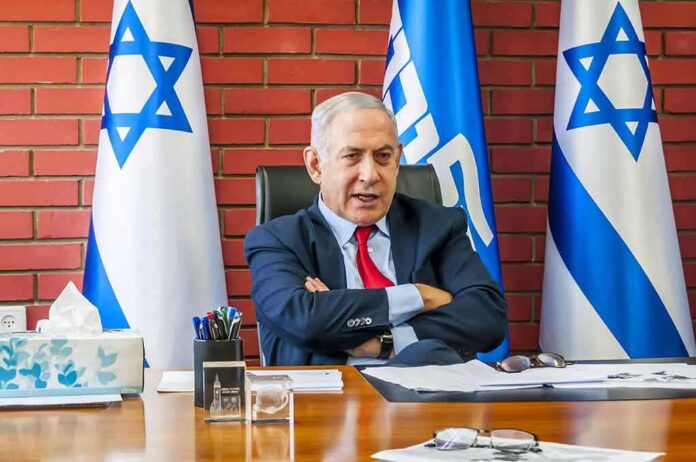
When a head of government says a foreign adversary tried to murder his child, he is not merely alleging a crime; he is signaling that the country’s contest with that adversary has crossed from the realm of policy into the intimate domain of family and personal security—where protective protocols, intelligence thresholds, and deterrence messaging collide.
The Short Version
- Benjamin Netanyahu stated in a live Channel 14 interview that Iran tried to kill one of his sons, without naming which son or providing operational details.
- Multiple outlets independently reported the same on-air allegation, confirming the statement’s content and context.
- Netanyahu linked the claim to security arrangements for political figures, referencing discussions with Shin Bet leadership about family protection.
- The allegation sits within a long-documented pattern of Iranian external plots against dissidents, Israelis, Jews, and Western targets.
What Netanyahu said and why it matters
In a live phone interview broadcast by Israel’s Channel 14, Benjamin Netanyahu said Iran had targeted one of his sons and “tried to kill” him. He did not specify whether Yair or Avner was the intended victim and gave no details about timing, method, or perpetrators. The statement moved quickly across Israeli and international media, with consistent framing of the core claim and its lack of identifying particulars regarding which son or when. Netanyahu tied the allegation to the broader topic of security arrangements for candidates and indicated he had spoken with Shin Bet chief David Zini, suggesting the claim was linked to protective concerns rather than a rhetorical aside.
For a sitting prime minister to elevate a threat to the level of public allegation—particularly one naming a specific foreign adversary—matters for three reasons. First, it shapes domestic expectations about the scope and priority of protective security for political families. Second, it sends a deterrent message externally: Tehran is placed on notice that Jerusalem attributes personal, familial targeting to the Iranian state. Third, it anchors the claim inside an information environment where Iran’s history of extra-territorial targeting is not theoretical but deeply established in policy and legal records.
How this fits the pattern of Iranian external operations
Iran’s security organs—particularly the Islamic Revolutionary Guard Corps (IRGC) and its intelligence arms—have, over four decades, executed or attempted assassinations, abductions, and hostile surveillance outside Iran’s borders. Research institutions and rights organizations that maintain incident databases document scores of operations across Europe, the Middle East, North America, and elsewhere, targeting dissidents, Israeli and Jewish figures, and Western officials and interests. A policy compendium published by the U.S. Institute of Peace’s Iran Primer similarly tracks Iran’s foreign plots and assassinations over multiple continents since 1979, underscoring the regime’s repeated use of deniable networks, proxies, and clandestine tradecraft to reach adversaries abroad.
This history does not resolve the specifics of Netanyahu’s allegation; it does, however, place the claim in a domain where Iranian intent and capability to mount external plots are well attested. Intelligence-driven threat streams often never become public case files precisely because the most probative indicators—intercepts, human sources, travel pattern anomalies—are classified. Protective services act on those thresholds, not on courtroom evidentiary standards, and they adjust coverage for principals and families accordingly.
Protective security mechanics when families are targeted
When a threat escalates from generalized intent to a credible plot indicator, protective details shift posture. That can include route randomization; increased countersurveillance around residences, offices, and habitual venues; hardened transport; and tighter movement discipline for family members who are most vulnerable because their routines are less institutionalized than a principal’s. Family protection is particularly complex: adult children may live abroad or maintain public profiles that generate additional telemetry—social media, event appearances—that adversaries can exploit. In Israel, Shin Bet’s unit for protecting state figures calibrates coverage based on threat intelligence and status; explicit linkage by Netanyahu to conversations with Shin Bet leadership therefore suggests the allegation intersects with operational protection decisions.
In practical terms, a state’s protective service is balancing two clocks. The first is the adversary’s operational cycle—surveillance, team assembly, weapon acquisition, and pre-attack rehearsal. The second is the defender’s cycle—detect, attribute, interdict, and harden. Public statements by the protected principal can serve multiple functions: justify resource allocation, warn the adversary of exposure, and frame domestic debate over the scope of family coverage.
Media transmission and evidentiary boundaries
The allegation traveled quickly through aligned and mainstream outlets because it came as a clear, attributable statement made on air, with identical core content across publications. The Times of Israel, Arab News, Gulf News, and Moneycontrol all reported the same formulation and highlighted the absence of identifying details; The Times of India added the context that the interviewer explicitly asked whether the claim derived from intelligence, to which Netanyahu responded it was “an unbelievable case”. That cross-outlet consistency establishes what was said and how it was framed—essential for public record—even as operational specifics remain undisclosed.
In high-policy security matters, this asymmetry is common: a dramatic assertion arrives with minimal public granularity because the underlying threat log, interdiction steps, and methods are sealed inside intelligence channels. The consequence is that the public conversation builds around the principal’s claim and the state’s protective posture, not around an open criminal docket. That is not a flaw of reporting so much as a structural feature of how protective intelligence works when adversaries operate transnationally and covertly.
Why name Iran publicly?
Leaders calibrate public attribution for strategic effect. Naming Iran—rather than an anonymous “foreign actor”—does several things at once. It places pressure on Tehran by increasing the reputational and diplomatic costs of further escalation; it buttresses domestic arguments for sustained protective resources for the leader’s family; and it aligns with an established narrative of Iranian external aggression that policy circles and the public can recognize. The Washington Institute’s survey of Iranian plots over “forty-plus years” is one widely cited example used in policy discourse to contextualize such threats. The Iran Primer’s long-range timeline of assassinations and plots functions similarly, giving the public a structured sense of frequency and geographic spread.
Public attribution also sets guardrails for third parties. If a plot involved intermediaries or took place on foreign soil, host nations and service partners now face an explicit statement of origin, which can catalyze joint investigations, surveillance tasking, and legal measures against facilitators. In parallel, the statement signals to Iranian proxies that family targeting is not a gray-zone tactic; it is treated as strategic aggression.
The policy implications going forward
Three implications follow. First, expect sustained or elevated family protection. Whether or not further details are disclosed, protective services will plan against recurrence, particularly for public-facing family members. Second, diplomatic channels will account for the allegation in any escalation-management calculus with Tehran and its aligned networks; external actors tend to read family targeting as a red line that narrows room for quiet de-escalation. Third, information discipline will likely tighten. If the underlying intelligence came from sensitive sources, the chance of official elaboration is low; the operational response—altered movements, visible security upgrades, and partner tasking—becomes the practical confirmation that the state is treating the threat as real.
Sources:
insiderpaper.com, gulfnews.com, arabnews.com, timesofisrael.com, english.varthabharati.in, aljazeera.com