
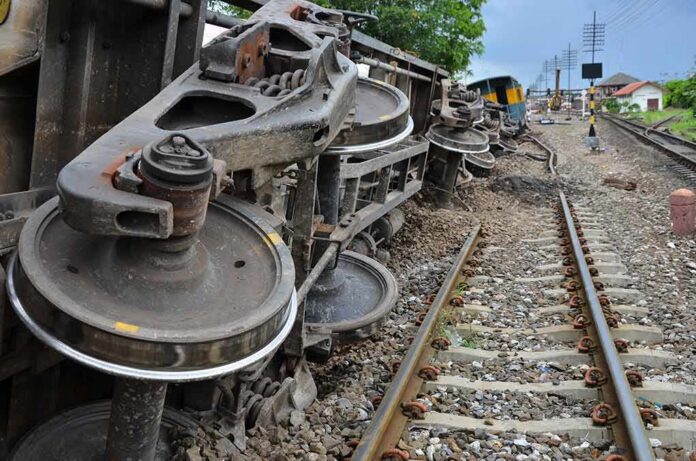
Russia’s repeated drone strikes on a Kyiv–Mykolaiv passenger train in Mykolaiv Oblast—and the railway’s swift evacuation that kept 168 people unharmed—capture the new logic of the war’s “battle for the railways”: not a single spectacular blow, but sustained pressure to make civilian mobility itself precarious.
At a Glance
- Passenger train No. 122 (Kyiv–Mykolaiv) was struck multiple times; all 168 passengers and crew were evacuated without injuries.
- Ukrainian Railways preempted casualties with an early warning and coordinated bus transfers to complete journeys.
- The attack, between Novyi Buh and Bashtanka in Mykolaiv region, fits a wider Russian campaign against Ukraine’s rail system.
- Rail-targeting has intensified since 2025, broadening from infrastructure to trains and locomotives themselves.
What happened to Train No. 122
On September 16, 2026, passenger train No. 122 running from Kyiv to Mykolaiv came under attack in Mykolaiv Oblast. The operator, Ukrzaliznytsia, reported that its monitoring team issued an early warning; the crew halted, disembarked passengers, and moved them to safety before the first strike. Local officials and multiple outlets describe not one isolated impact but a sequence: an initial hit followed by two further strikes against the same train over roughly two and a half hours. The acting regional governor stated that all 168 people—passengers and crew—were evacuated and that no one was wounded.
The attack occurred on the Novyi Buh–Bashtanka segment, a north–south rail corridor feeding Mykolaiv, an important regional center and logistics node near the Black Sea littoral. The immediate consequence was disruption, not mass casualty: the railway and the Mykolaiv Oblast Military Administration organized ground transport to complete journeys. Reports indicate 168 individuals from the train were moved by bus promptly, and, as the day unfolded, transfers scaled to move more than 650 people whose journeys were impacted by related service interruptions.
How the evacuation worked—and why it succeeded
Three elements explain the casualty-free outcome. First, detection and decision speed: Ukrzaliznytsia maintains a wartime monitoring posture—fusing air-raid alerts, radar and open-source cues—designed to trigger preemptive stops and disembarkations along safer segments. Second, crew discipline: train staff executed a practiced protocol to clear cars, control egress, and move passengers to standoff positions. Third, civil–military coordination: once the line segment was compromised, the oblast administration and the railway synchronized buses and dispatching to avoid dangerous chokepoints. Put together, these are not ad hoc heroics; they are the routinized survival mechanics of a rail network operating under persistent strike threat.
The figures can look inconsistent until you disaggregate them. The 168 total refers to the manifest of the specific Kyiv–Mykolaiv service at the time of the initial evacuation. The “more than 650” count reflects cumulative bus transfers across the operating day as rail movements were re-routed or paused on that corridor. Both are compatible: one is a car-level headcount, the other a network-level throughput metric once the attack rippled through the timetable.
Why Russia targets trains: strategy, not accident
This incident fits a clear operational pattern. Since mid‑2025, Russian forces have prosecuted a systematic campaign against Ukraine’s rail system—transformers, traction substations, yards, bridges, and increasingly, the rolling stock itself. Analysts describe the logic as theater-wide interdiction: degrade the capacity to surge materiel, disrupt civilian movement, sap morale, and force expensive dispersal of air defenses. By late 2025 and through 2026, reporting documented a sharp rise in strikes on rail assets, with September activity matching or exceeding monthly averages earlier in the year.
Ukrainian Railways and independent monitoring have tallied hundreds of locomotives and passenger cars damaged across the full-scale invasion. Open reporting through 2025–2026 points to nearly 1,200 railway-targeting incidents in 2025 alone, alongside thousands of damaged “railway objects”—a catch-all encompassing infrastructure elements from catenary supports to maintenance depots. Whether labeled as strategic interdiction or punitive pressure on civilian infrastructure, the operational effect is unambiguous: make rail an unreliable artery, hour by hour.
Mechanics of the strike: drones and repeated targeting
Local reports and officials attributed the train attack to drones—language that in this theater typically spans Iranian-designed Shahed loitering munitions and smaller first-person-view (FPV) systems. The notable feature was repetition: after the first detonation near the halted train, two additional strikes followed, suggesting a deliberate effort to re-attack the same target area rather than a single overflight with stray debris. This “re-attack” behavior aligns with observed Russian tactics against fixed infrastructure, now applied to a momentarily immobilized train—compounding disruption and complicating recovery actions.
In parallel that day, regional updates referenced damage to transport infrastructure and power outages across multiple Mykolaiv communities—further evidence that the train attack formed part of a broader, synchronized strike package designed to stretch responders and multiply knock-on effects across mobility and energy.
4/ On September 16, drones attacked the Kyiv–Mykolaiv passenger train carrying 168 passengers and crew.
They were evacuated before the strike.On September 17, another attack occurred near an Odesa–Dnipro passenger train.
— Maria Drutska 🇺🇦 (@maria_drutska) September 18, 2026
Consequences for passengers, rail operations, and risk management
For passengers, the safety message is paradoxical but vital: trains remain lifesaving arteries in wartime—evacuating cities, moving medical staff, delivering aid—yet they operate under aerial threat requiring compliance with crew instructions and patience through diversions. For the operator, the incident validates investment in early-warning fusion, dispatcher authority to halt and disembark, and rapid surface-transport fallback capacity. The goal is resilience measured not only in infrastructure repaired but in journeys completed despite interruptions.
Strategically, Ukraine’s calculus is to keep rail reliable enough to underwrite both civilian life and logistics. Russia’s counter-calculus seeks to keep it just unreliable enough to force costly redundancies and erode confidence. The Mykolaiv train episode shows both impulses colliding: a train targeted repeatedly—and a system that absorbed the blow without bloodshed and restored movement the same day. That is not luck; it is system design maturing under fire.
Where this fits in the evolving campaign
The attack on No. 122 is not an outlier. It is a data point in an intensifying contest over a network that moves far more than passengers. Russian statements around adjacent dates acknowledged strikes on rail infrastructure believed to carry military cargo in western Ukraine; Ukrainian and international reporting across 2025–2026 chart a broadening from substations and yards to trains and locomotives themselves. In this context, a halted passenger service becomes a target of opportunity: visible, immobilized, and symbolically potent.
The operational response is equally clear: distributed timetabling; dynamic rerouting; hardened or camouflaged assets at nodes; and codified evacuation drills on open track. Each successful no‑casualty outcome buys strategic time—time to repair catenary, clear ballast, rotate rolling stock, and maintain public confidence that rail remains the backbone of national movement under strike-era conditions.
Bottom line
Russia struck the Kyiv–Mykolaiv passenger train multiple times; Ukraine’s railway and regional authorities evacuated everyone and finished the transport mission by road. The episode is emblematic of the war’s rail campaign: repeated, targeted pressure met by institutionalized resilience. The metric that matters is not whether a line is ever hit—it will be—but whether people survive and the network keeps moving. On this day, in Mykolaiv Oblast, both tests were passed.
Sources:
thegatewaypundit.com, intent.press, korabelov.info, reuters.com, ua.news, nikvesti.com, theguardian.com, nbcnews.com, understandingwar.org, bbc.com, bankingnews.gr