
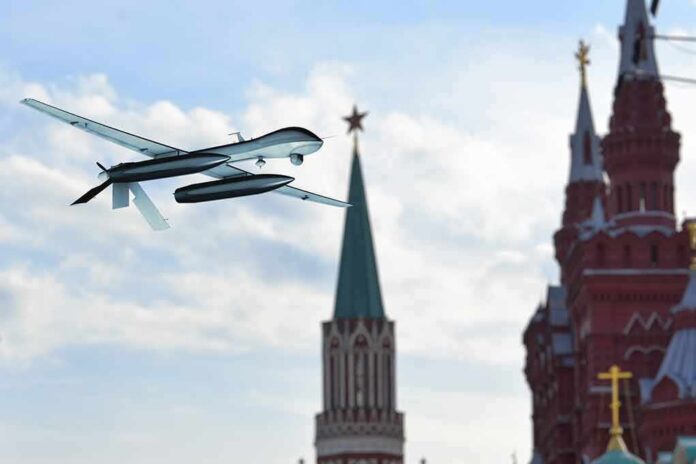
Massed, long-range drones have turned the Russia–Ukraine war into a contest of industrial capacity and air-defense endurance, and the largest Ukrainian strike on Moscow to date shows how this new regime works: quantity saturates, defenses blunt, and strategically chosen penetrations still shape the battlefield and the narrative.
At a Glance
- Ukraine launched a large, multi-directional drone operation into Russia, with hundreds aimed at Moscow and more than 1,000 reported overall.
- Russian authorities said air defenses intercepted the vast majority; Moscow’s mayor cited 450 drones downed on approach to the capital and over 1,600 intercepted nationwide since the prior day.
- Despite interceptions, drones reached Moscow’s oil refining complex and a residential building; Russian officials reported at least two deaths.
- The timing—during the final day of Russia’s parliamentary elections—underscored the political signaling embedded in modern drone warfare.
What We Know: A Record-Scale Raid That Still Scored Penetrations
Ukraine mounted a massed drone attack into Russian territory, with multiple outlets reporting more than 1,000 drones launched overnight and hundreds routed toward Moscow. Moscow’s mayor described the event as the city’s “largest ever” drone assault and said 450 drones were destroyed en route to the capital; wire services and Russian officials framed the broader national volume of intercepted drones in the 1,100–1,600 range, depending on timeframe and accounting method. Even within those defensive claims, Russian authorities acknowledged several drones reached the Moscow Oil Refinery and that a residential building was struck, with at least two fatalities reported in the Moscow region.
The operation’s purpose was twofold. Militarily, to stress Russian air defenses across multiple axes and test the seams in radar, electronic warfare, and point-defense coverage guarding the capital and its energy infrastructure. Politically, to bring the costs of the war to the Russian heartland on the final day of parliamentary elections and to demonstrate that Ukrainian long-range strike capacity remains scalable despite Russian countermeasures. That some drones hit an oil facility—high-value in economic and logistics terms—confirms the target set was coherent and not merely symbolic.
How Mass Drone Offensives Work: Saturation, Layered Defenses, Selective Breakthroughs
Large-scale drone raids are built on dispersion and quantity. A strike package may blend slow, inexpensive propeller UAVs; faster one-way “loitering munitions”; and, at times, longer-range cruise-style drones. Routes are chosen to ride terrain and exploit suspected gaps, with navigation that can fall back from GPS to inertial or visual guidance to ride out jamming. Defenders counter with a layered architecture: long-range surveillance radars cue interceptors; medium-range systems thin the wave; point defenses (guns, short-range missiles) mop up leakers. Electronic warfare adds non-kinetic attrition by breaking control links, spoofing navigation, or forcing altitude changes that make drones easier radar targets. In practice, a defender can chalk up imposing interception counts yet still face a handful of successful hits—enough to start fires at a refinery or crack an apartment façade. That is precisely what unfolded around Moscow.
This dynamic is not new; what is new is scale. Attacks previously described in the low hundreds now move into four figures at the theater level. Russia has adopted a similar logic against Ukraine, ramping its own drone usage month over month, which has pressed Ukrainian air defenses and forced costly, continuous alerting cycles for energy and industrial sites. The result is a war of cumulative stress—on stockpiles, operators, maintenance crews, and replacement pipelines for interceptors and UAVs alike.
Why The Numbers Vary—and What Actually Matters
Wartime reporting on raid size and intercept totals is inherently noisy. Launch counts reflect operational security and propaganda aims; interception tallies are dispersed across services and time windows; and post-strike damage assessments emerge under political pressure. The record here is consistent in shape, if not in every digit: very large launch volumes; high interception claims; and admitted penetrations to valuable energy infrastructure and a civilian building with casualties. Analysts should care less about the precise count than about the ratios and outcomes: did the defender sustain operations; did critical assets go offline; and did the attacker achieve strategic messaging at an acceptable cost. On those measures, Moscow’s defenses endured, but Ukraine proved it can still reach into high-value urban and industrial targets under heavy air-defense pressure.
Target Choice: Oil Refineries as Leverage Points
Strikes on refineries are not incidental. Fuel production underpins ground logistics, aviation training cycles, and domestic economic stability. Even modest damage can force shutdowns and rerouting, with outsized ripple effects in a system optimized for steady-state throughput. Russian officials and independent reporting have repeatedly acknowledged refinery disruptions after Ukrainian strikes; in this case, Moscow’s refinery in the Kapotnya area was among the targets that registered damage, consistent with Kyiv’s broader campaign to offset Russia’s long-range attacks on Ukrainian power and fuel nodes.
The choice also speaks to cost exchange. A single drone costing tens of thousands of dollars damaging process units worth millions is a favorable asymmetry for the attacker. For the defender, interceptors and point-defense ammunition are finite and expensive; layered defense must be sustained nightly, not episodically. Over time, this attritional math weighs on stockpiles and maintenance cycles as much as on physical infrastructure.
Elections, Signaling, and the Home-Front Theater
Russian officials asserted the attack was meant to disrupt the parliamentary vote and emphasized that polling proceeded regardless. That claim of continuity is itself part of the strategic signaling: the state projects resilience; Ukraine signals that the war reaches the capital and can touch critical assets on politically sensitive dates. This is the logic of coercive demonstration—shaping perceptions of control, safety, and inevitability rather than seeking decisive battlefield destruction in a single air raid.
Such operations also test public tolerance and administrative agility. Fires near major cities, debris in residential districts, and rolling air-raid alerts impose psychological and economic costs that a government must absorb and narrate away. Conversely, each successful interception and quick repair buttresses the defender’s claim that life goes on. The Moscow strike fits squarely in this reciprocal influence campaign.
What Changes Next: Industrialization, Adaptation, and Defense Economics
The through-line is industrial scale. Ukraine’s ability to assemble and launch swarms at four-figure volumes implies domestic production lines, decentralized launch cells, and maturing command-and-control that can orchestrate multi-axis pressure under electronic attack. Russia’s ability to register hundreds of interceptions around a single metropolis implies an expanded belt of sensors, mobile point-defense units, and EW coverage that has grown denser and more practiced over time. Both sides are iterating—faster airframes, more resilient navigation stacks, cheaper propulsion, smarter fusing, and counter-UAV interceptors purpose-built for this fight.
The strategic consequence is a steady, grinding contest over sustainment: who can build and launch more effective drones, who can reload defenses faster, and who can repair critical infrastructure sooner. Refinery hits and residential damage in Moscow show that perfect defense remains elusive; high interception totals show that saturation alone does not guarantee deep systemic disruption. The advantage flows to the side that couples quantity with intelligent target selection and that compels the other to spend disproportionately on nightly defense. The latest Moscow raid demonstrates Ukraine can still do that under the gaze of Russia’s thickest air-defense umbrella—and that Russia, while bloodied at the margins, can keep the lights on and the vote running even as sirens wail.
Ukraine unleashed a large-scale overnight drone and missile attack targeting Moscow and the surrounding region on Sunday, the final day of Russia’s parliamentary elections. https://t.co/XVKmI57McP
— NBC Montana (@NBCMontana) September 21, 2026
Bottom Line
This is what modern long-range drone warfare now looks like: large numbers in the air, even larger numbers claimed shot down, and nonetheless enough leakers to ignite a refinery and scar an apartment block. It is a war of production lines and air-defense magazines as much as of brigades and battalions. Moscow’s defenses held, but not perfectly. Ukraine’s message landed—literally and figuratively.
Sources:
usnews.com, independent.co.uk, cnn.com, english.mathrubhumi.com