
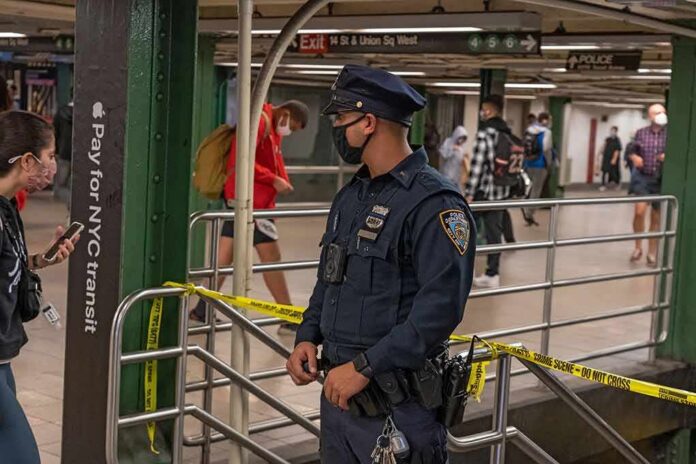
When a service pistol goes off inside a subway station, even without life‑threatening wounds, it exposes the unforgiving physics of confined spaces and the equally unforgiving obligations of firearms discipline in transit policing.
At a Glance
- An NYPD officer’s service weapon discharged at the Kingston–Throop Avenues subway station in Bedford–Stuyvesant around late afternoon; the department characterized it as accidental.
- Bullet fragments struck another officer and a 34‑year‑old bystander; all three were treated and later released from the hospital.
- The NYPD’s Force Investigation Division is handling the review, and two officers were placed on modified duty during the inquiry.
- Accidental or non‑adversarial discharges are a recognized category in NYPD reporting and national research on police firearms use.
What happened at Kingston–Throop
According to contemporaneous accounts, an NYPD officer unintentionally discharged her service weapon at approximately 4:40 p.m. inside the Kingston–Throop Avenues station in Bedford–Stuyvesant. Reports describe fragment injuries rather than a direct gunshot wound: one officer and a nearby commuter, a 34‑year‑old woman, were hit by bullet fragments and transported for evaluation. Both officers involved and the civilian were reported in stable condition and were subsequently released after treatment. The department placed the matter with its Force Investigation Division, and two officers were moved to modified duty during the review.
While early descriptions differ on whether the firearm left its holster, the shared factual core is clear: this was an accidental discharge inside a busy transit node, resulting in minor injuries to a bystander and an officer, and it triggered the NYPD’s established post‑incident mechanisms for review and duty reassignment.
Why fragment injuries happen in confined transit spaces
A single pistol round can behave unpredictably once it meets tile, steel, or concrete—materials that define most subway stations. Many jacketed handgun rounds will deform or fragment on impact with hard surfaces; energy dissipates as shards and spall that can lacerate skin and cause puncture wounds at short distances. Ricochet angles are dictated by the round’s construction, velocity, and the surface’s hardness and angle. In a platform or mezzanine environment, even a round discharged into the deck can fragment upward, sending secondary projectiles laterally toward knees, thighs, or faces. That is why negligent or accidental discharges, even when the muzzle is not oriented at a person, still pose material risk in transit settings. The observed outcome here—fragment injuries to those adjacent to the point of impact—is mechanically consistent with a round striking a hard surface and breaking up.
Officers train to keep muzzles oriented in a safe direction and to maintain strict trigger discipline for precisely this reason. The four cardinal safety rules—treat every firearm as loaded; never let the muzzle cover anything you are not willing to destroy; keep your finger off the trigger until your sights are on target and you have decided to fire; be sure of your target and what is beyond it—are not abstractions. In an environment where hard surfaces abound and bystander density is high, the margin for error narrows to near zero.
What the NYPD’s review process entails
Within the NYPD, a firearms discharge—whether adversarial, animal, unintentional, or off‑duty—enters a defined investigative and review pipeline. The Force Investigation Division (FID) handles scene documentation, ballistic recovery if available, interviews, body‑worn camera and surveillance collection where applicable, and firearms function testing to distinguish operator error from mechanical failure. Department policy folds firearms discharges into the broader use‑of‑force reporting system, with annual publication of aggregate data and categories that replaced the earlier, narrower Annual Firearms Discharge Report series.
From a practitioner’s perspective, several questions typically anchor an FID case file in an unintentional discharge: Was the firearm manipulated at the time, and if so, for what operational reason? Did any retention holster mechanism or foreign object interfere with the trigger path? Where did the round first strike, and do recovered fragments corroborate the stated muzzle orientation? Those answers determine whether the incident is classified as negligent handling, equipment failure, or another defined category, and they guide any remedial training or discipline.
How common are accidental or non-adversarial discharges?
Accidental and other non‑adversarial discharges are neither mythical outliers nor the norm; they are a known slice within a shrinking overall pie. The NYPD’s most recent published Use‑of‑Force report recorded 48 firearms discharges in 2023, a double‑digit percentage drop from the year prior, continuing the long arc of decline in New York City police shootings over decades. Earlier RAND analyses of NYPD discharge records, commissioned to evaluate training and review processes, observed that a substantial share of historical discharges fell outside classic adversarial gunfights—accidental discharges and animal shootings were notable components—reinforcing that prevention requires targeted training and equipment policies, not only tactics for suspect engagements.
Nationally, professional bodies have documented a dramatic long‑term reduction in total shots fired by large agencies since the 1970s, driven by training reforms, policy tightening, and improved equipment. Yet the stubborn residual category of unintentional discharges persists, often clustering around handling during administrative tasks, stressful transitions, or holstering with foreign‑object interference. In other words, the floor has moved lower, but gravity still exists.
Training, holsters, and the transit context
Transit units operate in dense crowds, narrow platforms, and dynamic choke points like turnstiles—an environment that complicates textbook firearms safety. Retention holsters are essential for weapon security but can add manipulation steps that, if rushed or fouled by clothing drawstrings, gear straps, or even debris, elevate risk. Modern striker‑fired pistols with internal safeties are highly reliable when kept in quality holsters that fully cover the trigger guard; problems emerge when something intrudes into that guard as the gun is seated or withdrawn. Agencies, including the NYPD, have long tuned holster selection, belt layout, and in‑service training to minimize such failure modes, and after‑action reviews often lead to incremental changes in gear or technique.
The Kingston–Throop event illustrates the policy tension: transit policing justifies visible presence and readiness, but readiness must be achieved without elevating the risk envelope for riders. That is not paradox; it is a design problem solved by rigorous, scenario‑based training, disciplined weapons handling, and equipment that is forgiving of human factors under stress.
Accountability without theatrics
Three things matter most after an unintentional discharge that injures bystanders or colleagues. First, candor about classification: calling an accidental discharge what it is enables the correct remedial path—skills refreshers, equipment review, or discipline—rather than mislabeling it and missing the fix. Second, speed and quality of the technical reconstruction: trajectory mapping, fragment analysis, and function testing are not bureaucratic rituals; they are how agencies learn. Third, proportionate consequences that align with findings: honest mistakes under unusual mechanical conditions are not adjudicated the same as negligent handling. The NYPD’s system exists to make those distinctions in a defensible way, and its annual reporting architecture gives the public a line of sight into the broader pattern, not just the headline.
The immediate facts in this case are straightforward: an NYPD service weapon inadvertently discharged in a Brooklyn subway station, fragments injured two people, and all parties were released after treatment. The professional obligations that follow are equally straightforward: investigate precisely, correct what is fixable—whether training, equipment, or practice—and document the outcome in the department’s public reporting so that the incident adds to institutional memory rather than disappearing as a one‑off anecdote.
An NYPD officer accidentally fired => her <= service weapon in a Brooklyn subway station Thursday afternoon — and bullet fragments struck another cop and a bystander.
The accidental discharge occured at about 4:40 p.m. inside the Kingston-Throop Avenue station in… pic.twitter.com/T9qelepY6J
— Crime In NYC (@Crime_In_NYC) September 12, 2026
What to watch next
From here, the meaningful markers are the FID’s classification and any public data points that follow in the next annual Use‑of‑Force report. If findings point to a discrete handling error, expect targeted retraining and, where warranted, disciplinary measures. If mechanical or holster factors contributed, look for guidance memos or procurement adjustments that harden the system against recurrence. The goal is not to eliminate all residual risk—that is impossible with firearms in crowded cities—but to keep forcing risk downward by designing systems for the way people actually work, move, and make decisions in real transit stations.
Sources:
nypost.com, bbc.com, nytimes.com, nyc.gov, policyarchive.org, jstor.org, theiacp.org